Contactless Payment
This guide describes the contactless payment flow where a Customer device connects to a specific Business terminal identified by a tag ID (e.g., via NFC/QR code scan) for direct payment.
Prerequisites
- A logged-in business user
- A logged-in customer with at least one valid payment instrument
- A Business terminal tag UUID to target the specific payment terminal
Flow overview
- Customer starts advertising via BLE with a specific tag ID and listens for payment events
- Business side creates a payment instance targeting the specific tag UUID and scans for BLE connections
- Information exchange occurs between business and customer devices once connected
- Payment request is sent by the business user and can be accepted or cancelled by the customer
- Payment acceptance is sent from the customer to the business user if approved
- Payment execution happens on both sides with the backend
Offline scenarios:
- If one side is offline, the online side handles the payment and shares results
- If both are offline, payment requires pre-authorization (experimental feature)
Let's check each step in more detail.
Customer: Receiving Contactless Payments
The customer needs to activate the contactless BLE payment stack with a specific tag ID to receive targeted payment requests. You need to connect to the business side via BLE and register as a payment receiver to be notified about any payment requests coming from the business side.
Important: The callback closure handles multiple events. When a payment is concluded the connection is terminated.
The usual flow of these events for a payment looks like:
receivedPaymentfinishedPaymentwhen the payment is concluded with success
alternate payment outcomes:cancelledin case the payment is cancelled by either side this indicates the end of a paymenterrorin case a payment or an established payment connection failsotherPaidin case the received payment was paid by another payee
disconnectedwhen the connection is closed
Customer — Listen for contactless payments from a specific terminal
The Customer device starts a direct BLE payment session with a specific Business terminal by providing its tag ID.
Note: This starts a short-lived payment session that automatically terminates after final payment events. Each session handles only a single payment - to receive another payment, call the receive method again.
let tagID = UUID() // Your specific service tag identifier

let paymentEvents = try vipaso.payment.customer.receiveContactlessPaymentRequest(tagID: tagID)

for await paymentEvent in paymentEvents {
    switch paymentEvent {
    case .cancelled:
        // Handle the cancellation
        handlePaymentCancellation()
    case .error(let error):
        // Handle the error case
        handlePaymentError(error)
    case .finishedPayment(let paymentResult):
        // Handle the case the payment is finished
        handleFinishedPayment()
    case .receivedPayment(let paymentRequest):
        // display payment for the user
        handlePayment(paymentRequest: paymentRequest)
    case .otherPaid:
        // Handle the case if another wallet paid the payment
        handleOtherPayment()
    case .disconnected:
        // Handle disconnection
        handleDisconnected()
    }
}
Example screenshots from our development application:
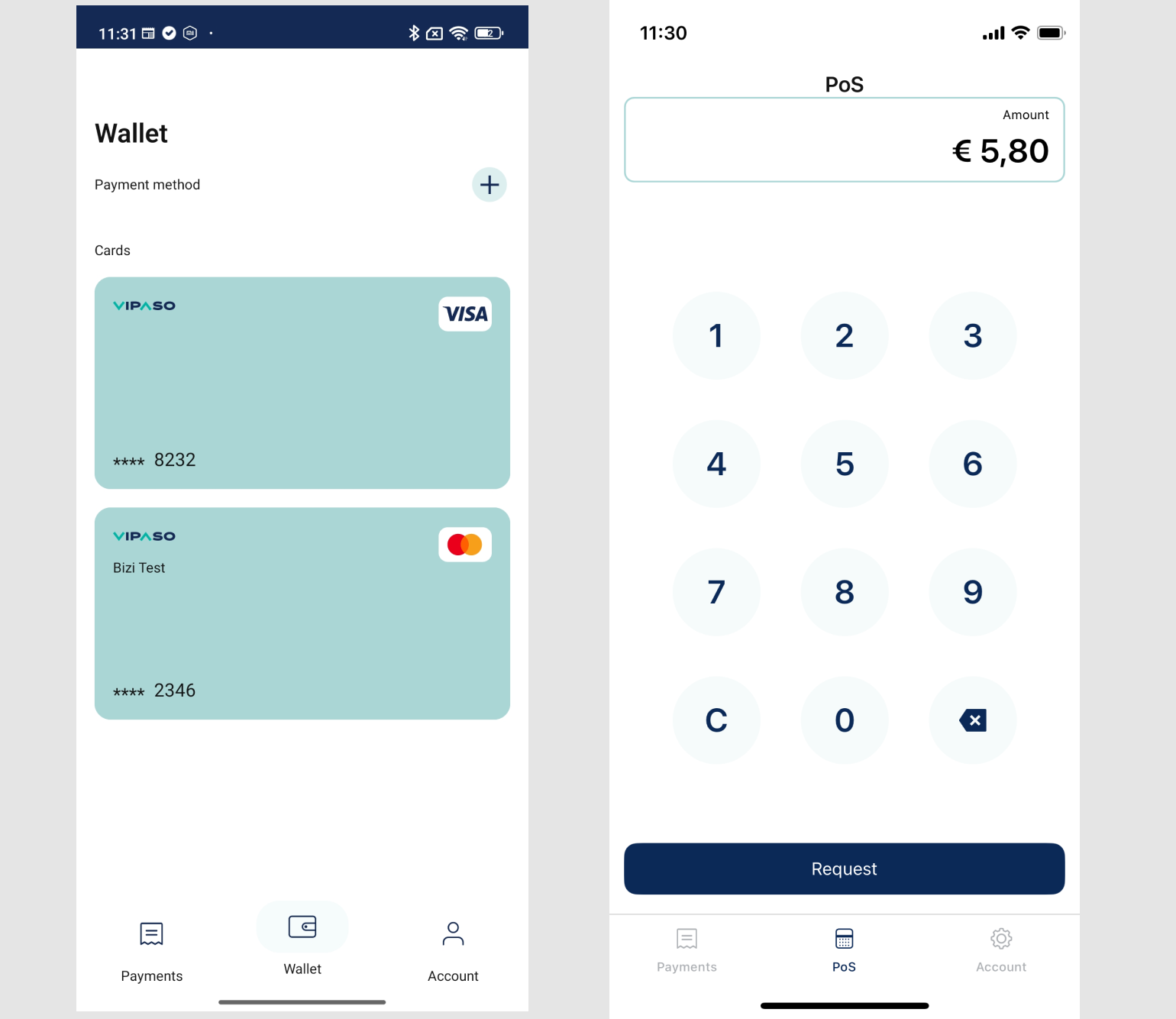
Business: Send contactless payment request
The Business device sends a direct payment request to a specific Customer device identified by tag ID.
Note: This creates a temporary payment session that ends automatically after the payment is complete. Each session handles one payment only.
let tagID = UUID() // The service tag UUID to target

do {
    let response = try await vipaso.payment.business.sendContactlessPaymentRequest(
        amount: "25.50",
        currency: "USD",
        paymentReference: "order-123", // Optional reference
        tagID: tagID
    )
    handlePaymentResponse(response)
} catch {
    handlePaymentError(error)
}
Accepting the Payment
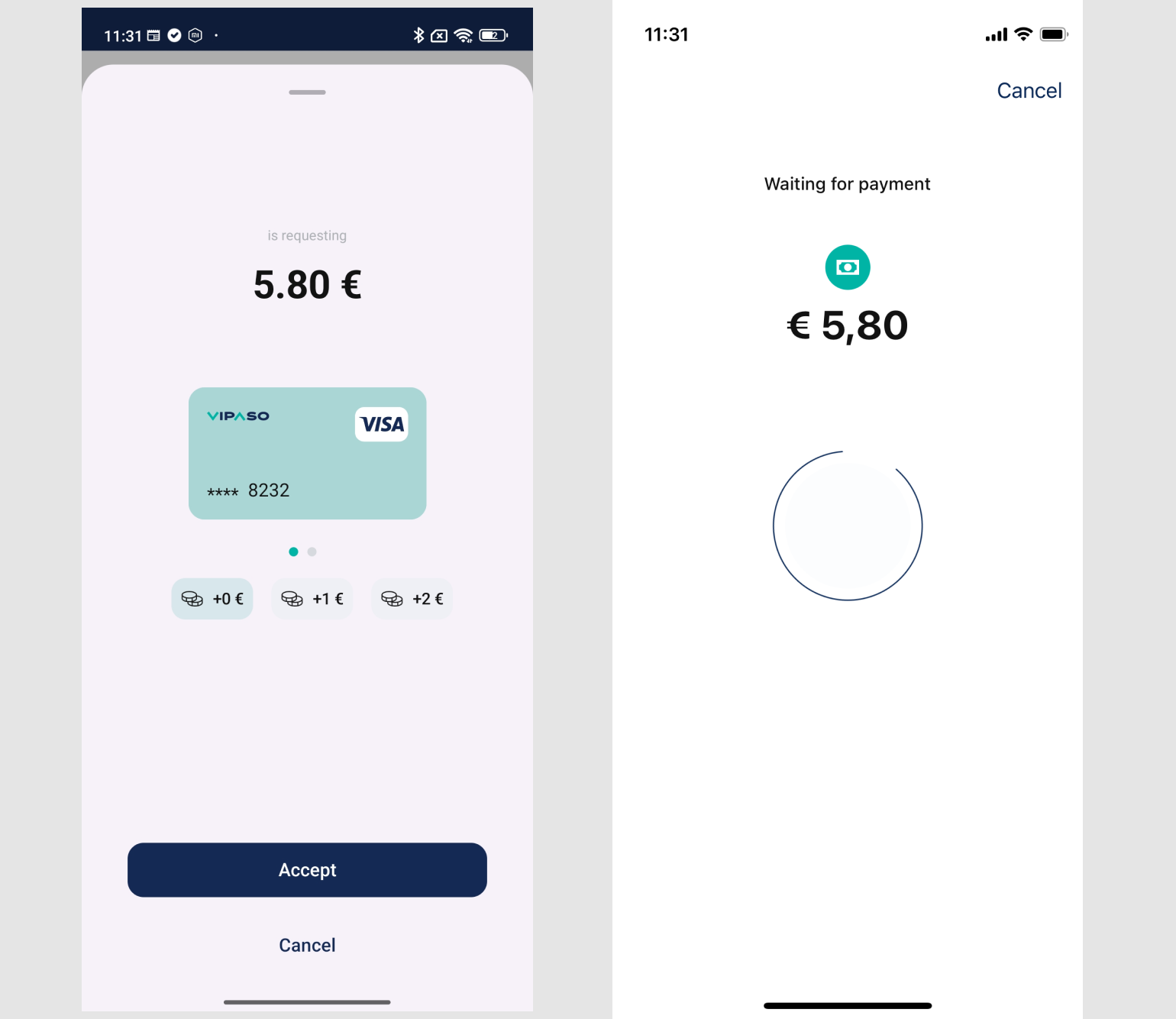
When an incoming payment request arrives via contactless payment, users can decide if they accept it. If the user accepts, send the acceptance to the Business device.
Instrument Types:
- Non-Delegated Instrument (
isDelegatedInstrumentID = false): An instrument created and managed on Vipaso using the Instruments API. - Delegated Instrument (
isDelegatedInstrumentID = true): An instrument created and managed on your own backend or app.
With instruments managed by Vipaso (Non-Delegated)
do {
    let request = VipasoPaymentAcceptanceRequest(
        paymentID: paymentID,
        amount: amount,
        tip: tip,
        currency: currency,
        instrumentID: instrumentID,
        createdAt: Date().iso8601String,
        isDelegatedInstrumentID: false // Set to true for delegated instruments
    )

    let success = try await vipaso.payment.customer.acceptPayment(request: request)
    handleAcceptanceSuccess(success)
} catch {
    handleAcceptanceFailure(error)
}
With client Delegated instruments
For instruments managed by your own backend or app, set isDelegatedInstrumentID = true.
do {
    let request = VipasoPaymentAcceptanceRequest(
        paymentID: paymentID,
        amount: amount,
        tip: tip,
        currency: currency,
        instrumentID: instrumentID,
        createdAt: Date().iso8601String,
        isDelegatedInstrumentID: true
    )

    let success = try await vipaso.payment.customer.acceptPayment(request: request)
    // Handle success
} catch {
    // Handle error
}
NOTE: The acceptance method call is the same. Only the input model changes.
Example screenshots from our development application:
Cancelling the payment
Customer side cancellation:
If the Customer does not accept a payment, they can cancel the operation:
IMPORTANT: When this call succeeds the customer will not receive this payment from the business side anymore.
do {
    let success = try await vipaso.payment.customer.cancelPayment(paymentID: paymentID)
    handleCancellationSuccess(success)
} catch {
    handleCancellationFailure(error)
}
Business side cancellation:
The Business can cancel the current payment, which terminates the session on both Business and Customer sides:
Important: When business cancels a payment, all connected customers are notified that the payment is cancelled and cannot pay it anymore and their sessions are automatically terminated.
vipaso.payment.business.cancelPayment()
Termination
To manually terminate the session at any time (e.g., user navigates away, app lifecycle events):
vipaso.payment.customer.terminatePayment()
//or
vipaso.payment.business.terminatePayment()

**Best Practice**: Always call `terminatePayment()` when a payment flow is concluded. The method is idempotent and won't cause issues if the session is already terminated or being terminated